“This page is exclusively dedicated to the immortal memories of my beloved Parents’ souls, late,Bibhuti Bhusan Roy and late, Gayatri Roy”.
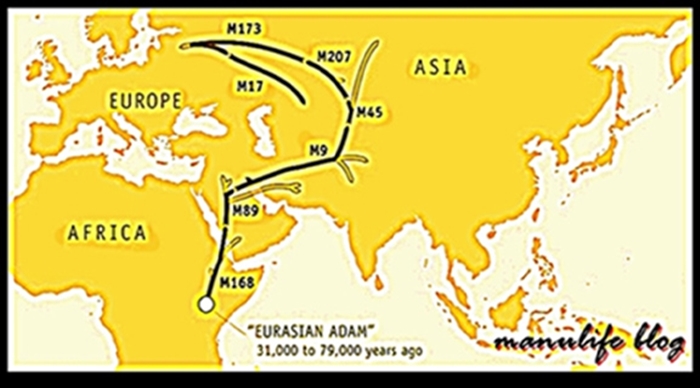
- Patrilineal ancestor may have belonged to tribes who spread out from around Ukraine, carrying with them the Indo-European language, which ultimately gave rise to most of the European, Iranian and North Indian languages.
- One can be 95% certain that there are no more than 62 generations to a common ancestor. A12 marker match means that there is about a 95% probability that the last common ancestor was around the beginning of the Common Era.
- The 95% confidence intervals on the estimates of the rates are in change per 1000 generations.
My family tree may be classified as R1a (M17) individual and my family tree may classify as belonging to haplogroup R1a1 (X R1a1 a/b/c) by SNP typing (M-124-M-157-M269-M343-M56-M64.2?M87-P25-SRY10831.2-M17+M173+M198+MM207+) just like 72% of the West Bengal Brahmins.
It has been variously named (prior to cladistic nomenclature) as belong to haplogroup 3, 1x, 1D, 45, Eu19, H16, or D, as per classification systems. The description traces back to nearly 100000 years.
At the Y-chromosome is passed on, small ‘mutations’ or copying errors (given names like M17; is an incomplete list) occur, dividing all of us into haplogroups (e.g.R1a) who share male ancestry. The deepest split is when the A haplogroup split away around 55000 years back (to within large errors) after which my ancestors got the markers SRY 10831.1, M42, M94 and M139. This was followed by the appearance of the markers M168 and P9 after splitting from people carrying the haplogroup B. The first individuals in whom these mutations occurred fathered all individuals living outside Africa, and is called the Eurasian Adam. He lived around 60000 BC, in Africa, some 3000 generations before us, and his descendants had a itchy feet, nomadically following the animals during a period of moist climate, or possibly driven by a population increase resulting from the favorable climate. Sophistication in tools and appearance observes as the generations progressed.
After a wave of emigrants left to populate the southern coast of Asia all the way to Australia, the markers P14, M89 and M213 made their appearance and being called the haplogroup F. Most non-African are actually the descendant of this individual (about 2200 generations back), who lived somewhere in northern Africa or the then grasslands of the Middle East around 43000 BC. His descendants went through Iran into Steppes of Central Asia possibly hunting game like buffalo, antelope and wooly mammoths.
Some 5000 years later, and say 2000 generations back, a man living in Iran or Southern Central Asia developed the marker M9 and all of us who descended from him are classified as haplogroup K (the descendants of the other haplogroup F people are totally called F*(XK), and so on for the other cases below).
His descendants are popularly called the Eurasian clan, and are a vast majority in Asia, Europe, and the Americas.
The next major set of markers M45, M74, P27, 92R7 and P63 (?) marked us as belonging to haplogroup P. These mutations arose from Pamir region amongst the Eurasian clan about 35000 BC, still more than 1700 generations before us. His descendants started in the game rich regions north of the Hindukush, but ultimately populated most of Europe and the Americas; even while surviving the ice age that was upon them.
The appearance of M207 then made us into group R, and M173 made it R1 (R2 the other haplogroup is marked by M 124 instead). These arose on the westward journey of the descendants of the haplogroup P individuals. In a simplistic way, one can theorize that it is the descendants of these people who brought cave painting to Europe, but our ancestors turned back last crossing back to Asia north of the Caspian Sea. Reality, of course, could be more complicated if, as is likely, appreciable diffusion and incorporation of outsiders was, taking place in those days, and any migrating group would be genetically heterogeneous to some extent.
A further mutation, SRY10831.2 (actually reverting back to the SRY10831- state it had in the A haplogroup) marks us as belonging to group R1a (M343 is the marker for R1b, P25 for R1b1, and M269 for R1b1C all negative for our family tree), and our family tree DNA may also contains the markers M17 and M198 meaning our family tree belong to R1a1. Our family tree however may not have the markers M56 for R1a1a, M157 for R1a1b, nor M 64.2 and M87 for R1a1c, and currently may be classified as the undifferentiated R1a1*.
The R1a1 group probably arose about 20 thousand years ago around the Hindukush mountains (or in Pakistan), but a major population may have moved north and started spreading out 10-15 thousand years or say 500 to 750 generations, back from somewhere possibly around Ukraine or Southern Russia. There is some reason to believe that these were the ancestors of the people who spread the Indo-European group of languages in the world, and possibly the steppes people that domesticated the horse. The R1a haplotype arose thousands of years before the origin of the Indo-European languages, and it is present indigenously in various places including India before the advent of Indo-European speaking people. On the other hand, linguistic conversion and cultural adoption is expected to be great enough that the people speaking mostly Indo-European languages could often harbor a mixture of haplogroups, and Indo-European migrations in various regions could even be mainly represented by different haplotypes. Recent research shows that the R1a1 people is probably far more complicated than a simple migration of Indo-European people either to or form India.
DNA extracted from ancient Siberian mummies from the Krasnoyarsk region of Andronovo, culture (2300-1000 BC) often associated Indo-Iranian innovations’, which is a precise match for our family tree.
We can’t confirm from this data, in which wave of people our family ancestors came into India with, but the reality shows out of large number of close matches (i.e. close enough such that the last common ancestor may be about a couple of millennia) in the Kazakhstan-Siberian region suggests a late migration. It is possible that our ancestor reached the Krasnoyarsk region-Egiin Gol Valley about three and a half thousands years back, then moved to the Amaty – IIi valley region at some point, and a branch moved out of there around the time of Christ and came to India. In fact, at least two historical migrations from that region, all the way to Transoxiana and Bactria and into India right around 2000 years back is known: the Yuezhi () (possibly the same as the Tocharians) who were thrown out northeastward out of their homeland, possibly near the Tarim basin-Gansu region in north western China by the Xiongnu around 177 BC, after settling in the IIi valley and forcing the Shakas settled around Issyk-Kul to move southwards to Bactria and India (Shakas, possibly related to the horse people, Kambojas), were themselves force to move south by the Uysyns/Wusuns by about 155 BC.
They finally reached India through Transoxiana and Bactria by the first century AD, possibly earlier at a time the Guishuang () tribe amongst them was in control and were called Kushans (possibly related to Rishikas) in later history here. The concentration in Poland-Slovakia region, and in Germany, is probably not due to the Gypsy movement out of India around a thousand to fifteen hundred years back since R1a is rather rare in the Romani populations today, but probably to the movement related to the settlement of Sakas Taradarya of the Darian inscriptions. The Viking spread of R1a1 is also supposed to originate in the same Russian steppe region.
Bengali Brahmins do not have any J2a, a west Asian lineage. They are predominantly Indo-Turks (R1a1). From Sengupta et al (2006) study:
R1a1=72%, R2=22% and H=6%
The Indian origin of paternal haplogroup R1a1* substantiates the autochthonous origin of Brahmins and the caste system.
Many major rival models of the origin of the Hindu caste system co-exist despite extensive studies, each with associated genetic evidence. One of the major factors that has still kept the origin of the Indian caste system obscure is the unresolved question of the origin of Y haplogroup R1a1* at times associated with a male mediated major genetic influx from Central Asia or Eurasia, which has contributed to the higher castes in India. Y-haplogroup R1a1* has a widespread distribution and high frequency across Eurasia, Central Asia and the Indian subcontinent with scanty reports of its ancestors (R*,R1* and R1a*) and derived lineages (R1a1a, R1a1b, and R1a1c). To resolve these issues, screened 621 Y-chromosomes (of Brahmins occupying the upper-most cast position and schedule castes/tribes occupying the lower-most positions) with 55 Y-chromosomal binary markers and seven Y-micro satellite markers and compiled an extensive dataset of 2809 Y chromosomes (681 brahmins and 2128 tribals and schedule castes) for conclusions. A peculiar observation of the highest frequency (upto 72.22%) of Y-haplogroup R1a1* in Brahmins hinted at its presence as a founder lineage for this caste group. Further, observation of R1a1* in different tribal groups, existence of Y haplogroup R1a1* in ancestors and extended phylogenetic analysis of the pooled data set of 530 Indians, 224 Pakistanis and 276 Central Asians and Eurasians bearing the R1a1* haplogroup supported the autochthonous origin of R1a1 lineage in India and a tribal link to Indian Brahmins. However, it is important to discover Y-chromosomal binary marker(s) for a higher resolution of R1a1* and confirm the present conclusions.
My genetic history:
My (our family) Y-chromosome results identify us (our family) as a member of haplogroup of R1a1.
The genetic markers that define our ancestral history reach back roughly 60000 years to the first common marker of all non-African men, M168, and follow our lineage to present day, ending M17, the defining marker of haplogroup R1a1.
If we look at the map highlighting our ancestors’ route, we shall see that members of haplogroup R1a1 carry the following Y-chromosome markers:
M168>M89>M9>M45>M207>M173>M17
Today a large concentration around 40 percent of the men living in the Czech Republic across the steppes to Siberia, and South throughout Central Asia an members of haplogroup R1a1. In India, around 35 percent of the men in Hindi-speaking populations belong to this group.
The M17 marker is found in only five to ten percent of Middle Eastern men. The marker is also in relatively high frequency around 35 percent among men living on eastern side of present day Iran.
What’s a haplogroup, and why do geneticists concentrate on the Y-chromosome in their search for markers? For the matter, what’s a marker?
Each of us carries DNA is the combination of genes passed from both our mother and father, giving us traits that range from eye color and height to athleticism and diseases susceptibility. One exception Y chromosome, which is passed directly from father to son, unchanged, from generation to generation.
Unchanged, that is unless a mutation – random, naturally occurring, usually harmless change – occurs. The mutation, known as a marker, acts as a beacon; it can be mapped through generations because it, will be passed down from the man in whom it occurred to his sons, their sons and their sons and every male in his family for thousand of years.
In some instances, there may be more than one mutational event that defines a particular branch on the tree. This means that any of these markers can be used to determine any particular haplogroup, since every individual who has one of these markers also has the others.
When geneticists identify such a marker, they try to figure out when it first occurred, and in which geographic region of the world. Each marker is essentially the beginning of a new lineage on the family tree of the human race. Tracking, the lineages provide a picture of how small tribes of modern humans in Africa tens of thousands of years ago diversified and spread to populate the world.
A haplogroup is defined by a series of markers that are shared by other men who carry the same random mutations.
The markers trace the path the ancestors belong as they moved out of Africa. It’s difficult to know how many men worldwide belong to any particular haplogroup, or even how many haplogroups there are, because scientists simply don’t have enough data yet.
My (our family) ancestral journey:
M168: My (our family) earlier Ancestor.
Appearance approximately 50000 years ago in Africa having climate of temporary retreat of Ice age, moves it (Africa) from drought to warmer temperatures and moisture. Number of Homo sapiens lived approximately ten thousands.
They used stone tools. Skeletal and archaeological evidence suggest that anatomically modern humans evolved in Africa around 200000 years ago, and began moving out of Africa to colonize the rest of the world around 60000 years ago.
The man who gave rise to the first genetic marker in our (our family) lineage probably lived in northeast Africa in the region of the Rift valley, perhaps in present-day Ethiopia, Kenya or Tanzania, some 31000 to 79000 years ago.
Scientist put the most likely date for when he lived at around 50000 years ago.
His descendants became the only lineage to survive outside of Africa, making him the common ancestor of every non-African man living today.
But why would man have first ventured out of the familiar African hunting grounds and into unexplored land? It is likely that a fluctuation in climate may have provided the impetus for our ancestors’ exodus out of Africa.
The African ice age was characterized by drought rather than cold. It was around 50000 years ago that the ice sheets of northern Europe began to melt, introducing a period of warmer temperatures and moister climate in Africa. Parts of the inhospitable Sahara briefly became habitable. As the drought-ridden desert changed to a Savanna, the animals hunted by our ancestors expanded their range and began moving through the newly emerging green corridor of grasslands. Our nomadic ancestors followed the good weather and the animals they hunted, although the exact route followed remains to be determined.
In addition to a favorable change in climate around this same time there was a great leap forward in modern humans’ intellectual capacity. Many scientists believe that the emergence of language gave us a huge advantage over other early human species. Improved tools and weapons, the ability to plan ahead and cooperate with one another, and an increased capacity to exploit resources in ways we hadn’t been able to earlier, all allowed modern humans to rapidly migrate to new territories, exploit new resources, and replace other hominids.
M89: moving through the Middle East.
Appearance approximately 45000 years ago in Northern Africa or the Middle East having climate semiarid grass plains with approximately ten thousand Homo sapiens lived there. They used tools like stone, ivory, wood tools etc.
The next male ancestor in our ancestral lineage is the man who gave rise to M89, a marker found in 90 to 95 percent of all non-African. This man was born around 45000 years ago in northern Africa or the Middle East.
The first people to leave Africa likely followed a coastal route that eventually ended in Australia, our ancestors followed the expanding grassland and plentiful game to the Middle East and beyond, and were part of the second great wave of migration out of Africa.
Beginning about 40000 years ago, the climate shifted once again and become cooler and more arid. Drought hit Africa and the grasslands reverted to deserts, and for the next 20000 years, the Saharan gateway was effectively closed.
With the desert impassable, our ancestors had two options: remain in the Middle East or more on. Retreat back to the home continent was not an option. While many descendants of M89 remained in the Middle East, others continued to follow the great herds of buffalo, antelope, wooly mammoths, and other game through what is now modern-day Iran to the vast steppes of Central Asia.
The semiarid grass covered plains an ancient ‘superhighway’ stretching from eastern France to Korea. Our ancestors, having migrated north out of Africa into the Middle East, they traveled both east and west along this Central Asian superhighway. A smaller group continued moving north from the Middle East to Anatolia and the Balkans trading familiar grasslands for forest and high country.
M9: The Eurasian clan spreads wide and far.
Appearance approximately 40000 years ago in Northern in Iran or Southern Central Asia with approximately ten thousand Homo sapiens lived there. Their tools and skills were like upper Paleolithic.
Our next ancestors, a man born around 40000 years ago in Iran or Southern Central Asia, gave rise to a genetic marker known as M 9, which marked a new lineage diverging from the M89 Middle Eastern clan. His descendants, of whom we are one, spent the next 30000 years populating much of the planet.
This large lineage, known as the Eurasian clan, dispersed gradually over thousands of years. Seasoned hunters followed the herds’ ever last world, along the vast super highway of Eurasian steppe. Eventually their path was blocked by the massive mountain ranges of south Central Asia – the Hindukush, the Tian Shan, and the Himalayas.
The three mountain ranges meet in a region known as the “Pamir Knot” located in present day Tajikistan. Here the tribes of hunters split into two groups. Some moved north into Central Asia, others moved south into what is now Pakistan and Indian subcontinent.
These different migration routes through Pamir Knot region gave rise to separate lineages.
Most people native to the northern hemisphere traces their roots to the Eurasian clan. Nearly all North Americans and East Asians are descended from the man described above, as are most Europeans and many Indians.
M 45: The journey through Central Asia:
Originated from Central Asia in a climate of glaciers expanding over much of Europe. Approximately one lakh Homo sapiens lived there. They used tools and skills like upper Paleolithic.
The next marker of our genetic heritage, M 45 arose around 35000 years ago, in a man born in Central Asia. He was part of the M 9 Eurasian clan that had moved to the north of the mountainous Hindukush and onto the game rich steppes of present-day Kazakhstan, Uzbekistan, and Southern Siberia.
Although big game was plentiful, the environment on the Eurasian steppes became increasing hostile as the glaciers of the ice age began to expand once again. The reduction in rainfall may have induced desert like conditions on the southern steppes, forcing our ancestors to follow the herds of game north.
To exist in such harsh conditions, they learned to build portable animal skin shelters and to create weaponry and hunting techniques that would prove successful against the much larger animals they encountered in the colder climates. They compensated for the lack of stone they traditionally used to make weapons by developing smaller points and blades – microliths – that could be mounted to bone wood handles and used effectively. Their tool kit also included bone needles for sewing animal skin clothing that would both keep them warm and allow them the range of movement needed to hunt the reindeer and mammoth that kept them fed.
Our ancestors’ resourcefulness and ability to adapt was critical to survival during the last ice age in Siberia, a region where no other hominids species is known to have lived.
The M 45 Central Asian clan gave rise to many more; the man who was its source is the common ancestor of most Europeans and nearly all Native American men.
M 207: Leaving Central Asia.
Originated from Central Asia in a climate of glaciers expanding over much Europe and Western Eurasia.
After spending considerable time in Central Asia, refining skills to survive in harsh new conditions and exploit new resources, a group from the Central Asian clan began to head west towards the European subcontinent.
An individual in this clan carried the new M 207 mutation on his Y chromosome. His descendants ultimately split into two distinct groups, with one continuing onto the European subcontinent, and the other group turning south and evidently making it as far as India.
Our lineage falls within first haplogroup, R1, and gave rise to the first modern humans to move into Europe and eventually colonize the continent.
M 173: Colonizing Europe – The first modern Europeans.
Originated from Central Asia around 30000 years ago in a climate of Ice age approximately one lakh Homo sapiens lived there. They used tools and skills like upper Paleolithic.
As our ancestors continued to move west, a man born around 30000 years ago in Central Asia gave rise to a lineage defined by the genetic marker M173. His descendants were part of the first large wave of humans to reach Europe.
Our ancestors’ arrival in Europe heralded the end of the era of the Neanderthals, a hominid species that inhabited Europe and parts of Western Asia from about 29000 to 230000 years ago. Better communication skills, weapons, and resourcefulness probably enabled our ancestors to out complete Neanderthals for scarce resources. This wave of migration into Western Europe marked the appearance and spread of what archaeologists call the Aurignacian culture.
The culture is distinguished by significant innovations in methods of manufacturing tools, more standardization of tools, and a broader set of tool types, such as end-scrapers for preparing animal skin and tools for woodworking.
In addition to stone, the first modern humans to reach Europe used bone, ivory, antler and shells as part of their tool kit. Bracelets and pendants made of shells, teeth, ivory, and carved bone appear at many sites. Jewelry, often an indication of status, suggests a more complex social organization was beginning to develop.
The large number of archaeological sites found in Europe around 30000 years ago indicates that there was an increase in population size.
Around 20000 years ago, the climate window shut-again, and expanding ice sheets forced our ancestors to move south to Spain, Haly, and the Balkans. As the ice age retreated and temperatures became warmer beginning about 12000 years ago, many descendants of M 173 moved north again to repopulate places that had become in hospitable during ice age.
Not surprisingly, to day the number of descendants of the man who gave rise to marker 173 remains very high in Western Europe. It is particularly concentrated in Northern France and the British Isles where it was carried by ancestors who had weathered the ice age in Spain.
M 17: The Indo-Europeans of the Steppes of Asia.
Originated from Ukraine or Southern Russia around 10000 to 15000 years ago in a climate of glaciers retreating. Approximately a few million Homo sapiens lived there. They were the first people to domesticate horse.
Our genetic trail ends with a marker that arose between 10000 to 15000 years ago when a man of European origin was born on the grassy Steppes in the region of present day Ukraine or Southern Russia.
His descendants became the nomadic steppe dwellers who eventually spread as far a field as India and Iceland. Archaeologists speculate that these people were the first to domesticate the horse, which would have eased their distant migrations.
In addition to genetic and archaeological evidence, the spread of languages can also used to trace prehistoric migration patterns. Our ancestors, descendants of the Indo European clan, may be responsible for the birth and spread of Indo-European languages. The world’s most widely spoken language family, Indo-Europeans tongues include English, German, Russian, Spanish, several Indian languages such as Bengali and Hindi, and numerous others. Many of the Indo-European languages share similar words for animals, plants, tools, and weapons.
Some linguistic believe that the Kurgans nomadic horsemen roaming the steppes of Southern Russia and the Ukraine, were the first to speak and spread a proto-Indo-European language, some 5000 to 10000 years ago.
Genetic data and the distribution of Indo-European speakers suggest the Kurgans, named after their distinctive burial mounds, may have been descendants of M 17.
Today a large concentration-around 40 percent of the men living from Czech Republic across the steppes to Siberia, and south throughout Central Asia are descendants of this clan. In India around 35 percent of the men in Hindi-speaking populations carry M 17 marker, where as the frequency in neighboring communities of Dravidian speakers is only about ten percent. This distribution adds weight to linguistic and archaeological evidence suggesting that a large migration from Asian steppes into India occurred within the last 10000 years.
The M 17 marker is found in only five to ten percent of Middle-Eastern men. This is true even in Iranian populations where Farsi, a major Indo-European language, is spoken. Despite low frequency, the distribution men carrying the M 17 marker in Iran provides a striking example of how climate conditions, the spread of language, and the ability to identify specific markers can combine to tell the story of the migration patterns of individual genetic lineages. In the Western part of the country, descendants of the Indo-European clan are few, encompassing perhaps five to ten percent of the men. However, on the eastern side, around 35 percent of the men carry M 17 marker. This distribution suggests that the great Iranian deserts presented a formidable barrier and prevented much interaction between the two groups.
My ancestral migration of marker M168, all non-African from the place of origin East Africa and migrated or out of East and then North Africa 50000 years ago, a few in members out of total approximate ten thousand Homo-Sapiens. Then the ancestors’ route of my haplogroup R1a1 carry following Y-chromosome markers located and resided in many places, which also described in my earlier chapter.
M168 > M89 > M9 > M45 > M207 > M173 > M17
M17 marker of haplogroup R1a1 originated in South Russia or Ukraine approximate 10000 to 15000 years ago, number of members of the group (M 17 marker) was unknown, and through crossing of eight cultures starting from ‘Bug-Dniester’ 6000 ya to Yamna and then succeeded by Andronovo and Afanasevo culture 3500 BC. (Source: Kurgan hypothesis).
In the period of Andronovo and then Afanasevo 3500 BCE; culture, eastward migration of Indo-Europeans was started.
M 168 (Africa) > M 89 (Northern Africa or the Middle East) > M 9 (Iran or Southern Central Asia) > M 45 (Central Asia) > M 207 (Central Asia) > M 173 (Central Asia) > M 17 (Ukraine or Southern Russia) of Haplogroup R1a1 (SRY 10831.2).
So, we can easily conclude the genealogy of Adam I (consort Kali)/ Manab/ Manvantara/ Manush (Basque word) to Ikshvaku/ Noah in a linear line as Adam I & Kali > Enki/ Vishnu > Siva/ Japheth/Dumuji > En-Sipad-Zid-ana / Lugalbanda/Gomer >Akhnukukh II/Ashkenaz > Shulgi/Puzur-Suen > Sukurlam/ Ubartutu/ Ur-Zababa > Ikshvaku/ Shuruppak/ Noah ~ Eight generations.
Now, It is the time to connect ‘Manu Genealogy’ to ‘Siddhartha’s Genealogy’, though both the names belong to myself co-incidentally, and reminds me to depict my genealogy from around 3600 BCE to present date (Approximate genealogy of 5610 years back to present).
You may think, it is absurd and works like a wastage of time, but to the best of my efforts around four years, it is possible me to connect the time frame, from various sources of religious books, ancient history and geography, recent genealogical and DNA study and study of more than hundred research works, archaeological, anthropological papers and obviously from our ancient family records.
Though I have tried to the best of my efforts to write something to integrate our homely world. Though I know there may some chronological disorder in lineages or in excess inclusion and sometimes matching the closely alternatives, but I always approach interested persons (may connect their genealogy to my ancestral line, if applicable) to edit these ancestry line at any time.
MY GENEALOGY |
||
| SL | NAME OF ANCESTORS |
Periods |
| 1 | IKSHVAKU / INDRA / PURU (RAVAS) | 3378-3350 BC |
| 2 | BIKUKSHI-NIMI / AYUS | |
| 3 | PURANJAYA / KUKUTSTH / JANAKA / VIDEHA / MITHI | |
| 4 | ANENAA / SU -YODHANA / UDAVASU | |
| 5 | PRITHU / NANDI-VARDHANA | |
| 6 | VISHVRANDHRI / SUKETU | |
| 7 | CHANDRA / AYU / ANDHRA / ARDRA / DEVARATA | |
| 8 | YUVNAASHAV | |
| 9 | SHAAVSAT | |
| 10 | VRAHADHASHAV | |
| 11 | KUVLIYAASHAV | |
| 12 | DHADHAASHV | |
| 13 | HARYASHAV | |
| 14 | NIKUMBH | |
| 15 | VARNAASHAV | |
| 16 | KRINAASHAV | |
| 17 | SENAJIT / PRASENJIT | |
| 18 | YUVNAASHAV | |
| 19 | MAADHAATAA | |
| 20 | PURUKUTS | |
| 21 | TRAS-HDRASU | |
| 22 | ANRANAY | |
| 23 | HRYASHAV II / ROHIDASHVA | |
| 24 | ARUN | |
| 25 | NIVDHAN | |
| 26 | SATYAVRIT / TRISHANKU / SHATA-DYUMNA | |
| 27 | HARISHCHANDRA | |
| 28 | ROHIT/ROHITASHVA | |
| 29 | HARIT | |
| 30 | CHUMP | |
| 31 | SUDEV | |
| 32 | VIJAY | |
| 33 | BHRUK | |
| 34 | VARK | |
| 35 | VAAHUK | |
| 36 | SAAGAR / SARGAON | |
| 37 | ASMANJAS | |
| 38 | ANSHUMAN | |
| 39 | DILIP | |
| 40 | BHAGIRATH | |
| 41 | SHRUTR | |
| 42 | NAAM | |
| 43 | SINDHDWEEP | |
| 44 | AYUTAAYU | |
| 45 | TRITUPARAM | |
| 46 | SARVKAAM | |
| 47 | SUDAAS | |
| 48 | ASHAAK | |
| 49 | NAARIKVACH | |
| 50 | DASHARATHA-I | |
| 51 | IDVID / SUSHRUTA | |
| 52 | VISHAV-SAH-I / JAYA | |
| 53 | KHATVAAG/DILIPA-II / VIJAYA | |
| 54 | DIRGHBAAHU / RITA | |
| 55 | RAGHU | |
| 56 | PRATHURSHRAVAA / SHUNAYA / SHUNAKA | |
| 57 | AJ (AJA) / VITAHAVYA | |
| 58 | DASHARATHA-II | |
| 59 | RAAM / BAHUL-ASHVA | |
| 60 | KUSH / KRITI | |
| 61 | ATITHI | |
| 62 | NISHADH | |
| 63 | NABH | |
| 64 | PUNDAREEK | |
| 65 | KSHYMDHANTA | |
| 66 | DEVANEEK | |
| 67 | AHEEN | |
| 68 | PAARIDHATR | |
| 69 | BALSTHAL | |
| 70 | VAJRNAABH | |
| 71 | SWAGANA | |
| 72 | VIDHRITI | |
| 73 | HRINYANAABH | |
| 74 | PUSHYA | |
| 75 | DHRUVSANDHI | |
| 76 | SHREEDHU / SHREEDNU | |
| 77 | MARU | |
| 78 | PRUSHRAT | |
| 79 | SANDHI | |
| 80 | AMARSHANA | |
| 81 | MAHSWAAN | |
| 82 | VISHAVSAHR | |
| 83 | PREYSENJIT | |
| 84 | TKSHAK | |
| 85 | VRAHADVAL | |
| 86 | VRAHADRAVAN | |
| 87 | URUKIYE | |
| 88 | VATSVRIDHA | |
| 89 | PRATIVIYOM | |
| 90 | BHANU | |
| 91 | DIVAAK | |
| 92 | VAAHINIPATI | |
| 93 | SAHADEV | |
| 94 | VEER | |
| 95 | BRIHADRATH | |
| 96 | BHAANUVAH | |
| 97 | PRATIKAASHAV | |
| 98 | SAPRATREEK | |
| 99 | MARU-DEV | |
| 100 | SAMKSHETRA | |
| 101 | PUSHKAR | |
| 102 | ANTARIKSH | |
| 103 | SUTAP / SUBARNA / SUPARNA / SUSENA | |
| 104 | AMITRAJIT / SUMITRA ( KING OF KOSALA ) | |
| 105 | BRIHADWAAJ / BRAH-DHWAJ (KING OF KOSALA) | 900 BC |
| 106 | KASAYAPA | |
| 107 | KAUTSA | |
| 108 | GAURATREYA | |
| 109 | VASKA | |
| 110 | KANNDIRTAA | |
| 111 | BHAARADVJA II | |
| 112 | KANSIKA | |
| 113 | KATYANA | |
| 114 | BHAARADVJA III | |
| 115 | BHARGAVA | |
| 116 | PARASARA | |
| 117 | YASAKA | |
| 118 | SANKR’TYAANA | |
| 119 | AGNIVESYA | |
| 120 | VASISHTHA – II | |
| 121 | KAUNDINYIO | |
| 122 | BHARADVAJA – IV | |
| 123 | KASYAPA – II | |
| 124 | MANDAVYA | |
| 125 | KAVESTARA | |
| 126 | KRISHNATIEYA | |
| 127 | HARSHA PRABHA | |
| 128 | KAUTILYA |
Approx. 400-450 BC |
| 129 | SREYASKARA / GATI / GAURI – SOMA | |
| 130 | VAKULASOMA – SVAMIN | |
| 131 | DHRITI – SOMA | |
| 132 | SIMBA – SOMA | |
| 133 | BHAYASAH – SVAMIN | |
| 134 | YAJNA – SVAMIN | |
| 135 | DAIVA – A – VAID | |
| 136 | DARDDI – SVAMIN | |
| 137 | PRADYUMNA -SVAMIN | |
| 138 | VRIDDHI -SVAMIN | |
| 139 | KHANDA – SOMA – SVAMIN | |
| 140 | GAUTAMA | |
| 141 | SANATANA – SVAMIN | |
| 142 | SRADDHADASA – SVAMIN | |
| 143 | ARKA – SVAMIN | |
| 144 | JANARDANA – SVAMIN | |
| 145 | SARPPINI – SVAMIN | |
| 146 | MANA. SVAMIN | |
| 147 | HAMPINAGA | |
| 148 | TOSHA – NAGA | |
| 149 | APANGA – SVAMIN | |
| 150 | PRAVARA – NAGA – SVAMIN | |
| 151 | NARA – SVAMIN | |
| 152 | GANJA – SVAMIN | |
| 153 | SADHU – SVAMIN | |
| 154 | TOSHA – KUNDA – SVAMIN | |
| 155 | SAKTI – KUNDA – SVAMIN | |
| 156 | ISVARA – KUNDA – SVAMIN | |
| 157 | NARAYANA – SVAMIN | |
| 158 | SRADDHA – KUNDA – SVAMIN | |
| 159 | YASO – KUNDA – SVAMIN | |
| 160 | ? AIIBHAKA (SIUN-SVAMIN) / YAJNA – KUNDA – SVAMIN | |
| 161 | SUDARSANA [AND DINAKARA] | |
| 162 | ISVARA – DATA – SVAMIN | |
| 163 | VAJASANEYIN MAUDGALYA | |
| 164 | KUSHMANDA – PATRA – SVAMIN | |
| 165 | CHAKRA – DEVA – SVAMIN | |
| 166 | MADHU – SVAMIN | |
| 167 | RAJAPATI – PALITA – SVAMIN | |
| 168 | MITRA-PALITA [AND ARLIAPANTA] | |
| 169 | SUCHI – PALITA – SVAMIN | |
| 170 | VISHNU – PALITA – SVAMIN | |
| 171 | VISHNU – SOMA – SVAMIN | |
| 172 | DHRUVA – SOMA – SVAMIN | |
| 173 | MADHU – SENA – SVAMIN | |
| 174 | VARUNA – SVAMIN | |
| 175 | YASO – BHUTI – SVAMIN | |
| 176 | BHUYASKARA – SVAMIN | |
| 177 | BHANU – SVAMIN | |
| 178 | ARKA – SVAMIN | |
| 179 | GOPENDRA – SVAMIN | |
| 180 | SUDASHANA – SVAMIN | |
| 181 | VISHNU – SVAMIN | |
| 182 | NARAYANA – SVAMIN | |
| 183 | MANORATHA – SVAMIN | |
| 184 | SII – YFTSU / SOMA – VASU | |
| 185 | DIVAKARA | |
| 186 | HARI | |
| 187 | ADBHUTA / AHDHUTA | |
| 188 | TVAEBTN / TVA – AHTRI | |
| 189 | TOSHA – NAGA – SVAMIN | |
| 190 | MEDHA – SVAMIN | |
| 191 | DHRITI – SVAMIN | |
| 192 | KESAVA – SVAMIN | |
| 193 | GAURI – SVAMIN | |
| 194 | SUOHARITA – SVAMIN | |
| 195 | BAPPA – SVAMIN | |
| 196 | KARKADATA – SVAMIN | |
| 197 | UDAYANA – SVAMIN | |
| 198 | MERUDATA – SVAMIN | |
| 199 | NARENDRA – SVAMIN | |
| 200 | RENUBHUTI – SVAMIN | |
| 201 | MEDHABHUTI – SVAMIN | |
| 202 | CHANDRA PRAKASHA – SVAMIN | |
| 203 | KALI – SVAMIN | |
| 204 | [ YASKA ] – SVAMIN | |
| 205 | BHATTI – MAHESVARA -SVAMIN | |
| 206 | GOPALANANDI – SVAMIN | |
| 207 | VISUABHUTI – SVAMIN | |
| 208 | SURAKHSITA – SVAMIN | |
| 209 | SUCHARITA – SVAMIN | |
| 210 | SIVAGANA – SVAMIN | |
| 211 | VASU – SRI – SVAMIN | |
| 212 | VIRABHUTI – SVAMIN | |
| 213 | VISHNUBHUTI – SVAMIN | |
| 214 | PRAMODA – BHUTI – SVAMIN | |
| 215 | VISHAITIDATA – SVAMIN | |
| 216 | BRIHASPATI – SVAMIN | |
| 217 | HARSHADEVA – SVAMIN | |
| 218 | MEDHA – SVAMIN | |
| 219 | HUVMMI……….. . | |
| 220 | MADHAVA – SVAMIN | |
| 221 | HARI – SVAMIN | |
| 222 | JANARDANA – SVAMIN | |
| 223 | VISHNU – SOMA – SVAMIN | |
| 224 | DHANA – SENA -SVAMIN | |
| 225 | PRAMODA -SENA – SVAMIN | |
| 226 | GHOSHASANA – SVAMIN | |
| 227 | SOMA -SENA – SVAMIN | |
| 228 | SUSENA | 1078 AD |
| 229 | BRAHMAI OJHA | |
| 230 | DAKSHA | |
| 231 | PITAMBAR | |
| 232 | HIRANNA – GARBHA | |
| 233 | VEDA – GARBHA | |
| 234 | VHU – GARBHA / JIGNI / GIGNEE | |
| 235 | SWARNAREKHA | |
| 236 | SANDUKA OJHA | |
| 237 | MAITAI (MAITRAKUL) | |
| 238 | STHIR | |
| 239 | DOYACHARYA | |
| 240 | MAHANIDHI (MAITRA GANCHI) | |
| 241 | BRHASPATI | |
| 242 | KUPA OJHA (MADHYAM-GRAM SOCIETY ) | |
| 243 | NARASINGHA | |
| 244 | SUKI | |
| 245 | MADHU MAITRA (MADHYAM – GRAM SOCIETY) | |
| 246 | MADHAI MAITRA ( MATIKOPA VILLAGE OF MEHARPUR SUB-DIVISION, NADIA AND SETTLED IN MURSHIDABAD ) | |
| 247 | RAGHURAM ROY (‘ROY’ AWARDED BY THE NAWAB OF BENGAL ) | |
| 248 | JUGHOL KISHORE ROY | |
| 249 | SRIKRISHNAKANTA ROY | |
| 250 | ANANDA MOHAN ROY | |
| 251 | SRIMANTA ROY | |
| 252 | MAHENDRA NARAYAN ROY | |
| 253 | PHANI BHUSAN ROY | |
| 254 | BIBHUTI BHUSAN ROY,
WIFE GAYATRI ROY |
Up to 1991 and
2007 respectively. |
|
(My beloved parents) |
||
 "Manulife Blog"